Thursday, December 4, 2008

Waterhouse Writes Book in Nine Days!

Steve started his writing career in a way that most of us dream about.  A nationally recognized publishing house contacted him and asked him to write a book on sales. 

DSC01934 - Steve Waterhouse cropped & compressed

Tonight we had the pleasure of having Steve Waterhouse speak to our group.  Steve is an accomplished sales consultant and author. Steve shared tips for working with a large publishing house, such as contract negotiation and how to manage a timeline for writing your book. 

One of the many valuable tips Steve shared was Dianna Booher’s 13-step process for writing a book.  Once his research was complete, Dianna’s strategies enabled Steve to write his book in nine days!

DSC01925 

Steve Waterhouse is a consultant and author who helps organizations around the world improve their sales and leadership development. In his unique career, he has been an engineer on the Patriot Missile System and directed a 300% turnaround of Vortech Corporation in just 24 months.

His consulting, lecturing and training have directly helped 10's of thousands of people in 38 states, 10 countries and 4 continents. His clients include IBM, Boston Scientific, Xerox, and United Airlines. He is the author of The Team Selling Solution: Creating and Managing Teams That Win the Complex Sale, (McGraw-Hill).

Mr. Waterhouse has a BSEE from Syracuse University and holds the CSP, the highest earned award from the National Speakers Association.

To learn more about Steve’s writing and consulting, visit him at Waterhouse Group

by Linda Harvey, FCCW VP of Membership

Thursday, November 20, 2008

King Lays Down Life to Make Time to Write

Author Michael Ray King revealed he was a closet writer for twenty years before he decided to come out into the open. Due to insecurity, he felt his knowledge inferior or unworthy to be presented to the public.

DSC01480 cropped

Using John 3:16 as his guiding principle, he shed this apprehension. He concluded that he truly loved writing; therefore, he would lay down his life and “make the time” to write and ensure his book was published. Through intense research, he established his own publishing company and learned the art of creative self-publishing. His discussion was filled with exciting new ways to print, promote and sell.

His main advice to fellow writer’s: use John 3:16 as your guide, every day write 500 word articles at www.articles.com, and blog twice a week.

Together, Mike and his wife Bobbie, co-founded ClearView Press, Inc. in May 2007. Learning the publishing side of writing has been and continues to be an exciting and challenging part of their busy lives. As they move forward with new books, they wear many hats - author, publisher and marketer/promoter.

In this first of what will be many publications, Michael Ray King makes his debut with one of his favorite subjects, Fatherhood 101: Bonding Tips for Building Loving Relationships. The opportunity to help other men learn what it means to be a solid, caring father is his top priority. Through books, white papers, pamphlets, speaking engagements and consulting, Michael hopes to have a positive impact on the lives of fathers and their children.

Michael won a Royal Palm Literary Award Honorable Mention at the 2008 Florida Writers Association Conference for his book Fatherhood 101

By Priscilla Weaver, VP PR First Coast Christian Writers

Thursday, November 13, 2008

Author Auth Reveals Emmy's Question

Jeannine Auth was at her computer making final revisions to an historical novel she’d been working on for almost five years when she felt a tap on her shoulder.

image

Her granddaughter, Emily, who was ten at the time, plopped her diary on Jeannine’s desk and said, “Grannie, I’ve been thinking about this. You’re a writer. I want you to take my diary and make a book out of it so other kids like me—other children of alcoholics—will know they’re not alone. They need to know they can still be okay even if their parent doesn’t get well. But they’ve got to know to ask somebody for help.”

Jeannine flipped through the journal pages filled with shame, bewilderment, and anger--but also love and hope. Right then, she filed the historical novel away in the bottom of a filing cabinet, and Emmy’s Question was born. Although inspired by the writing and drawings in Emily’s diary, the story has been fictionalized to include experiences of other children of alcoholics as well. There are over 11 million children under the age of eighteen in the U.S. who have an alcoholic parent–not counting kids whose parents are drug-addicted. These children for the most part don’t have a voice and do not get help. They live in a culture of shame, denial, “don’t tell”, and isolation. Having worked through her own pain and understanding, “Emmy” became their voice.

Jeannine devoted the next two years to writing Emmy’s Question. The title came from Emily’s struggle to answer the question: How could Mommie choose wine over me?  Her ultimate understanding that she could find the best in herself in spite of her parent’s alcoholism is a message of hope to any child living under the cloud of  parental addiction. The book is carefully researched, and won the endorsement of the Betty Ford Center prior to publication. Jerry Moe, the Children’s Program Director for Betty Ford, critiqued the manuscript to ensure that information and messages presented were in keeping with current-day understanding of the special needs of these children.

Emmy’s Question has won a number of prestigious awards and multiple endorsements. It was published by Morningtide Press, a small independent publishing company owned by Jeannine and her husband, Dennis.  The book is available through bookstores nationwide and all on-line booksellers. It is being used in counseling practices, schools, and rehab centers. She hopes to complete a sequel to Emmy’s Question over the next year, as well as resuming work on her earlier novel.

image

Jeannine stressed the need for aspiring writers to study and learn the craft of writing. She advised the group on some do’s and don’ts of the writing trade and suggested several books she found especially helpful. These books include:

The Craft of Writing, William Sloane

Self-Editing for Fiction Writers, Browne & King

The Art of Fiction, John Gardner

Makely Shapely Fiction, Jerome Stern

The Elements of Style, Strunk & White

Bird by Bird, Ann Lamott

Members and guests gathered around Jeannine after the program concluded to ask questions. Jeannine graciously offered sage advice to those hoping to break into the publishing field.

By Ron Moore, Member First Coast Christian Writers

Thursday, October 16, 2008

Chicken of the Sea Author Says Surfing Saves

"God gave me surfing to save me," says Paul Hayden, author of Chicken of the Sea. What almost drowned him as a child saved him as an adult. He tried numerous times over the years to write the book, but today it's a reality.

IMG_8624

When he lived in Long Island, Paul's friends used to call him the "Chicken of the Sea" because he was afraid of the surf after a near-death experience in the water. Not only did he overcome this fear, but surfing has become one of his passions. Paul says that surfing gives him strength--that the ocean is cleansing. Paul chose to publish this book with Tate, a partnership publisher.

Paul encourages writers to have the faith and conviction not only to write, but also to publish. It takes courage to write about your own life and the people you know, but it's also healing to do so.

After his book was published, one of the teachers from his high school wanted to add his book to her curriculum, but shortly after, she left the school so it didn't work out. What a great idea, however, for schools and colleges to use the books of their graduates!

Paul is currently working on a faith-based novel which he hopes to title, The Nonconformist. He also has a children's book, Byron the Lonely Christmas Tree, coming out very soon. He doesn't use scripture in his faith-based books. He tells his story just like it is from the joy and pain in his life--this is how people can see his faith.

"Write from your heart. Write what you know." Paul writes in a conversational style, no big words.

He writes all his first drafts long-hand. He picked up this habit when he was traveling a lot. He learned to make the most of his time whether he was in an airport, hotel or restaurant. He burned through quite a few ink pen refills and he saves the empty ones to quantify his progress.

"If you don't have a name, it's difficult as a first time author, but don't give up. Be patient. God has a plan for you. It's really great when people write to you and tell you that  you've made a difference in their lives."

"Don't let anyone talk you out of following your dream," says Hayden. "And be sure to set deadlines, or you'll never get anything done!"

Thursday, October 9, 2008

Wood Brings Books into the Classroom

"If the story is in you, it will come out," is what Jane learned from a UNF professor. Jane used to outline her writing and plan everything out before she wrote. But today she prefers not to worry much about outlining and structure, but focuses on letting the stories happen more organically.

IMG_8549

Jane's books are for readers age 9-14. To be sure that she doesn't lose touch with her audience, Jane keeps up with movies and activities targeting children 9-14.

"My husband is a good sport, he'll see the movies with me," says Wood.

She has found her niche among teachers and students. Most of her presentations are in schools.  Her books tell a story and provide history and other lessons for students. Jane also provides teachers with resources to use in the classroom: vocabulary words, discussion questions, an electronic scavenger hunt and more.  Jane's first three books have been a great success and she's working on two more to add to her collection.

About Jane:

Jane Wood was born in Astoria, Oregon, a community rich in Scandinavian heritage. Jane’s family moved to Cocoa, Florida, when she was ten. She grew up near Cape Canaveral and watched America’s journey into space first-hand. During two of her college summers, she worked at the Kennedy Space Center.

She graduated from the University of Florida with a major in history and a minor in English. She taught junior high and high school in Central Florida, but left the classroom when her first son, Jonathan, was born. Three years later, along came Brian.

Jane remained a “stay-at-home mom” while her sons were growing up in Jacksonville, Florida. She was involved in school parent groups, Boy Scout activities, and their athletic associations. Jonathan played baseball, soccer and ran cross-county in high school. Brian played baseball, soccer and football in high school. Today Jonathan lives in Jacksonville Beach with his wife Jennifer, and Brian coaches college baseball and conducts clinics for coaches and young players.

When the boys were older, Jane spent three years writing part-time for a local newspaper. After earning a Masters degree in Education in 1988, she went to work at the local cable company as the Educational Programming Coordinator. During her 12 years there, she produced numerous television shows relating to education, including many that involved local youngsters in the productions.

Jane has also been involved in many international activities in her community. She is active in the Jacksonville Sister Cities Association and was elected to the board of directors for Sister Cities International. She has traveled to three of Jacksonville’s sister cities in Russia, China and France. Jane lives in Jacksonville, Florida, with her husband Terry. They like to travel and spend time with their family and friends.

Thursday, September 25, 2008

Victims' Advocate Editor Speaks Up for People

This evening, Shirley Shaw, Editor of Justice Coalition's Victims' Advocate spoke at FCCW. She told the story of how the Justice Coalition came about and how she became involved with the organization.

IMG_8284

Shaw also told us the story of an amazing man, Terry Lane, whom she describes in her article entitled, "Look at the Children," in the Sept/Oct 2007 issue of Today's Christian.

Shirley clearly has a passion for telling stories of the many interesting people she meets.

Thank you for inspiring all of us this evening Shirley!

Wednesday, September 24, 2008

Your First Readers Aren't Your Audience

This evening, author Vic DiGenti reminded writers that our first readers aren't always our audience. The person who buys the book isn't necessarily the person who reads the book.

IMG_8147

Vic suggested that writers do six things in an open:

  1. Get the reader hooked.
  2. Establish a bond between the reader and the lead character.
  3. Set the scene through dialogue or action--show, don't tell.
  4. Get conflict going.
  5. Describe the hero or heroine briefly so readers can picture him or her.
  6. Surprise or startle the reader.

"Writing is an obsessive-compulsive behavior," say DiGenti. I find this to be true as I continue on my quest for researching, experiencing, writing and publishing more and more ideas. There's never enough time to observe and write, experience and write, think and write, read and write! Anyone else agree?

Hope to see you soon at First Coast Christian Writers.

Thursday, August 21, 2008

Tropical Storm Fay Rains On FCCW

This is the first time we didn't hold a weekly meeting since we first started in January. The storm pounded Jacksonville with wind and rain, leaving many residents without electricity. Trees were down and local officials urged people to stay home as tornado warnings persisted into the evening.

See you next week, God willing.

Thursday, May 22, 2008

Inez Announces Weeder's Digest Success Story

IMG_4601

First Coast Christian Writer member, Inez Holger, announced her success story this evening. Her article entitled, 'Life, Death, and Cabbages,' appears in the Summer 2008 edition of GreenPrints Weeder's Digest.

IMG_4607

If you're interested in getting published, come visit our writing critique group that meets Thursday evenings.

Thursday, May 8, 2008

Harvey Speaks About Her Powerful Practice

"Do as I say, not as I did," says Linda Harvey, member of First Coast Christian Writers. This evening Linda provided tips for writers who are considering self-publishing. She spoke about her experience self-publishing her book, Powerful Practice.

IMG_4072

If you're interested in learning more about the publishing industry, come join us Thursday evenings for First Coast Christian Writer's meetings at Christ's Church near the intersection of I-95 and 295.

Thursday, April 17, 2008

Writing for Magazines & Literary Journals

This evening, Inez Holger covered the basics of writing for magazine publication, a venue that can add valuable writing credentials to your resume. Here are her top six tips:

  1. Identify your writing style
  2. Identify your market
  3. Match 'em up
  4. Study your intended publication
  5. Shift your style
  6. Submit, submit, submit

IMG_3138

Identify Your Writing Style

What kind of writer are you? It’s important to identify the type of writing you do so that you can find a magazine that fits your style. The number one complaint from editors is that writers send material that does not “fit” their publication. In other words, don’t send sci-fi to Guideposts. Some categories to consider:

  • Essays
  • Humor
  • Short story (fiction)
  • Spiritual
  • Reporting (facts only)
  • Anecdotal
  • Creative non-fiction (apply literary techniques to non-fiction)
  • Intellectual (In-depth analysis of complex topics)

clip_image002

Identify Your Market

Once you have a grasp of the style of writing that you gravitate toward, you can then hone in on one or two of the HUNDREDS of markets looking for your work. For instance, in the market reference books listed below, you’ll find extensive lists of types of publications. For instance:

  • Adventure Nonfiction Travel
  • Arts Parenting Trade
  • Business Poetry Women’s Issues
  • Christian Regional (your part of the USA)
  • Children Religion
  • Cooking Science Fiction
  • Diet/Nutrition Senior Citizen
  • Family Short Stories
  • Men’s Issues Self Help
  • A Christian marketing manual lists the following (partial listing!):
  • Church History Fillers (really short pieces)
  • Christian Home schooling Inner Life
  • Current/Social Issues Missions
  • Devotional Personal Growth
  • Doctrinal Prayer
  • Encouragement Social Justice
  • Essays Short Story
  • Healing Take-Home Papers
  • Humor Women’s Issues

Match “Em Up

If you always write funny pieces about your kids, then you can check out the markets on “Family,” or “Parenting.” Oh, you like to write stories FOR children. Check out the “Children” and “Teen/Young Adult” categories. Look under “Humor” just in case.

Now that you have a general idea, let’s get down to work.

clip_image004

Study Your Intended Publication

You’ve chosen “Highlights Magazine” and “Pockets.” Should you just go ahead and send whatever you’ve written? Not exactly.

1. Obtain writer’s guidelines

Most of these are on magazine web sites or on writer’s web sites.

The guidelines tell you what the publisher wants, the word count allowed, themes for certain months, when to submit, how to submit.

2. Read at least 3 copies of the magazine, which you can find at the public library, at book-store magazine racks, at church libraries, in

the doctor’s office! Request copies from the publication itself.

By studying what they publish, you’ll know if you truly can

write for them. You’ll find out if the editor is interested in pieces with a touch of humor or prefers anecdotes, especially from beginning writers. You often have to start with small pieces before the editor will trust you with bigger ones. Perhaps you aren’t quite up to their level of writing yet, but you can make a mental note and aim for the future.

3. For an in-depth look at a column or regular feature of a magazine, try

the following:

Take 4 colored markers and highlight these specifics as you read –

  • Quotes
  • Names and titles
  • Facts, statistics, technical lingo
  • Figurative language and structural details

Be sure that your article includes the same features.

Shift Your Style

As you study the magazine and writer’s guidelines, you find that your pieces always tend to have a word count of 2,000. They want 1,000. Start cutting. You write well for Catholic Digest but if you really want to send the piece to Guideposts, you might have to cut some references that are too denominationally specific. If you want to send the same piece to Reader’s Digest, you might need to take the same story and emphasize a different aspect (the adventure, instead of your biblical insight).

Tweak. Accommodate. In the process, you’ll get more practice writing!

If you don’t want to change anything, don’t send your piece anyway, hoping that the publisher will be so impressed that he/she will break his/her own rules.

Submit

Stick to the guidelines!!!!!!!!! Margins, paper, email, disk. SASE.

Stick it in the mail. clip_image006

Helpful Hints and Resources

  • Even though you are writing a book, consider magazine publications as a means to adding writing credits to your resume and as a possible means of opening doors with book publishers.
  • Consider writing for contests. The practice will improve your writing skills and who knows, you might even win.
  • You can check out back copies of magazines from the library.
  • “The Writer” has an ongoing updated list of markets and highlights a different market area each month. May 2008- History. Read the library copy instead of purchasing.
  • “The Writers’ Journal” has monthly market lists, with new magazines and very specific markets.
  • Consider trade magazines if you have particular expertise in an area. Agriculture, dentistry, retail, you name it.
  • Good web sites: www.writersdigest.com, http://www.pw.org/toolsforwriters, http://www.pwcwriters.org/links.htm
  • The following market guides will keep you busy:
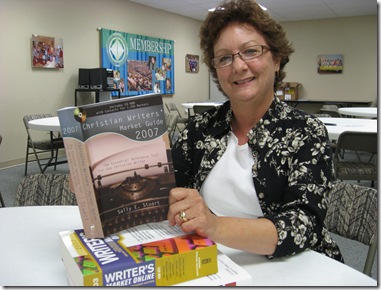
  • Christian Writer’s Market Guide by Sally Stuart
  • The American Directory of Writer’s Guidelines
  • Writer’s Market (available for several genres)

Last of all, don’t underestimate your life experiences. You cook, you clean, you eat, you raise children, you garden, you collect coins or salt shakers, you fix cars, you have relatives, you feel pain, you love cheesecake, you’ve seen every George Lucas movie, you play guitar, you’ve been young and now you’re old. Nothing to write about? Think again.

About Inez Holger

Inez has written since elementary school, completing a book of poetry by ninth grade. Her nonfiction works have appeared in various publications such as The Upper Room, Greenprints, The Family and Parenting Treasures. She worked as a contributing editor for Jacksonville Sports Magazine and wrote weekly news articles and features for a local community newspaper.

For the past several years she has had the opportunity to tutor students from home schooled and public school backgrounds while working on a collection of family vignettes and a series of devotions for Christians struggling with their faith.


Total Attendees at today's meeting:  9

New members joining today:

Total current members: 10

Thursday, April 10, 2008

Plan to Write Every Day

Do you write every day? Join us on Thursday, April 10, to learn more about Buddy's tips on how you can incorporate writing into your schedule every day.

IMG_2991

Buddy Putman